A communication pilot for future financial well-being
What’s Your Move? began with a practical question: how can Open Future Lab translate its foundational financial well-being research into something people can see, feel, react to and use?
The ambition was not to create another explanation of financial well-being. The Beyond Money research had already shown that financial well-being is human, emotional and multidimensional: a balance of security, freedom and pleasure, not a single financial score. It is about feeling able to choose, enjoy, recover, relate, and imagine a future.
The pilot set out to test how this research could become communication. Could a brand, a question, a website, a public activation and a set of conversations help people connect their future financial well-being with decisions made today?
The result was What’s Your Move? – a pilot platform, campaign identity and research-through-communication experiment built with FORA in 2025.
What we built
After a paid pitch process with four agencies, Open Future Lab chose FORA as the best match across mindset, strategic understanding, cost and deliverables. The initial brief had imagined a cultural movement around long-term thinking and financial self-care. FORA helped turn that ambition into a concrete brand and communication system.
The collaboration started in spring 2025 with strategy, brand development, design and channel planning. In summer, the first communication activities were rolled out and tested, including a live activation at the European Forum Alpbach. In autumn and winter, the collected material was published, analysed and used to develop further communication ideas.
The pilot created several layers:
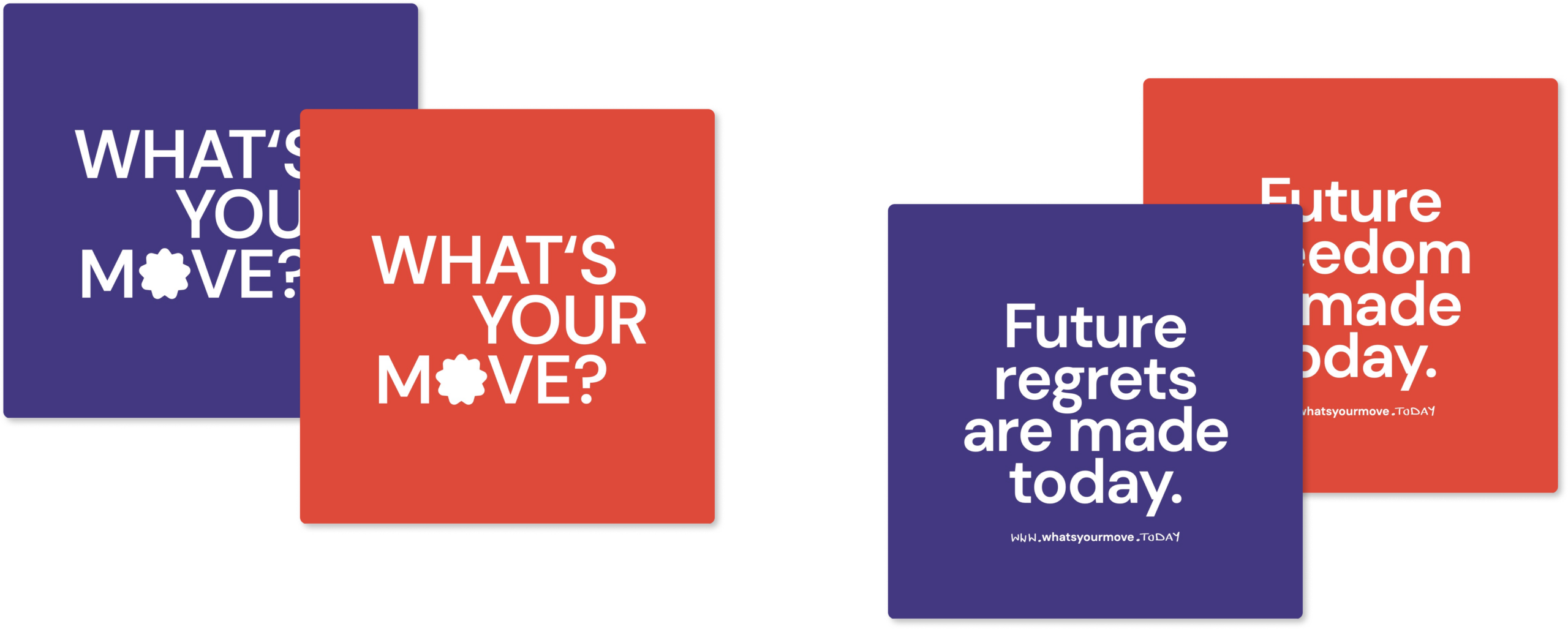
A brand identity with a bold name and visual language.
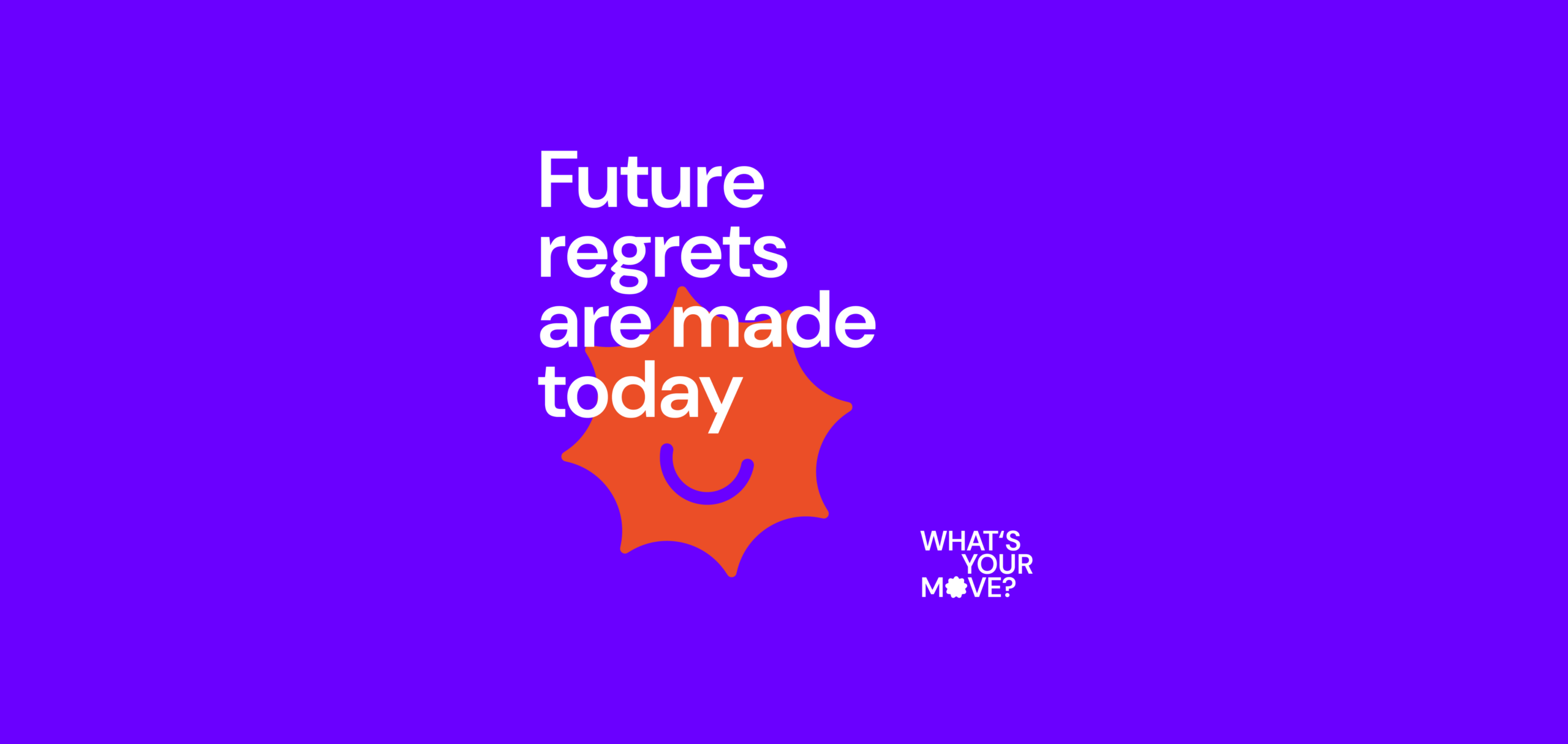
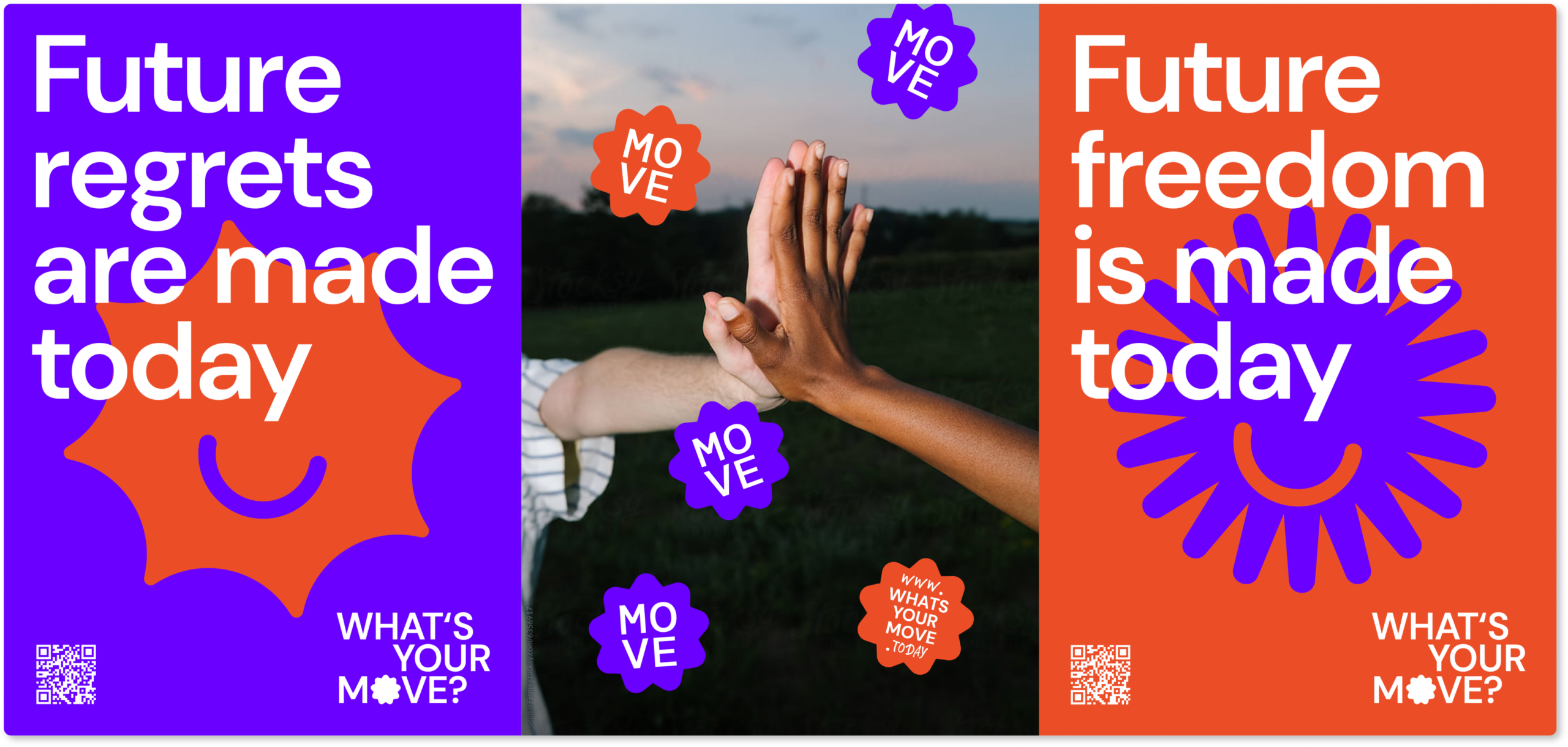
A claim: Future regrets are made today. What’s your move?
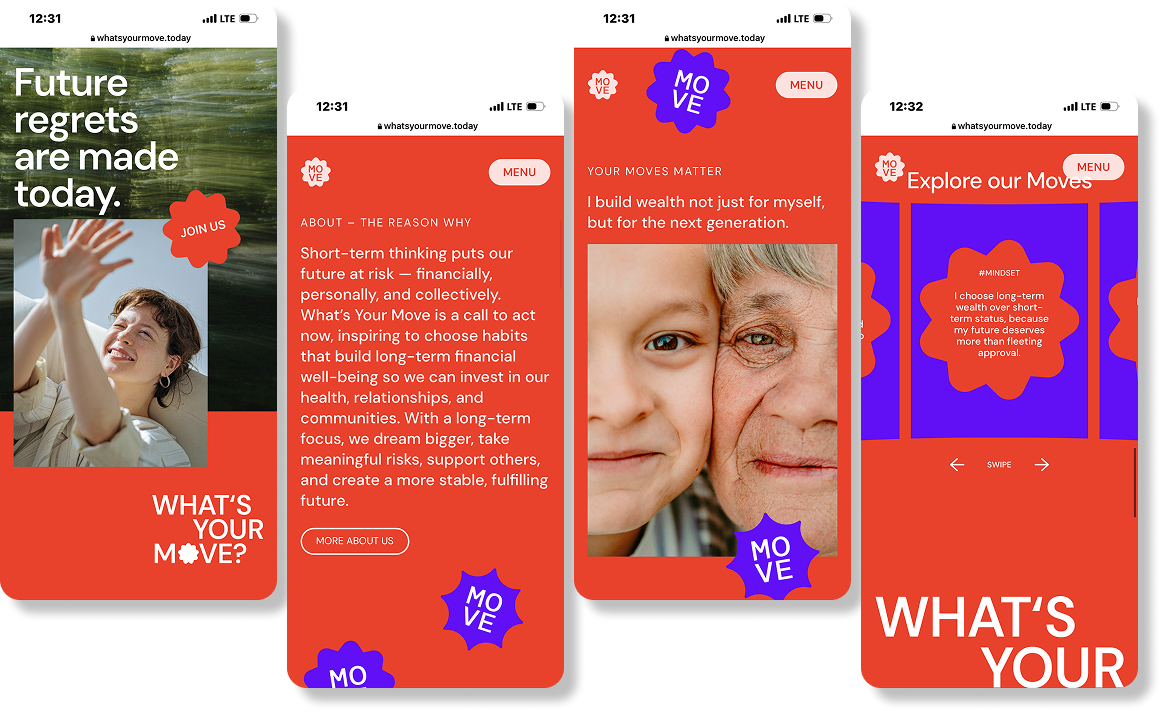
A website: whatsyourmove.today.
An Instagram channel with moves, interview clips and educational content.
A manifesto video capturing the essence of the idea.
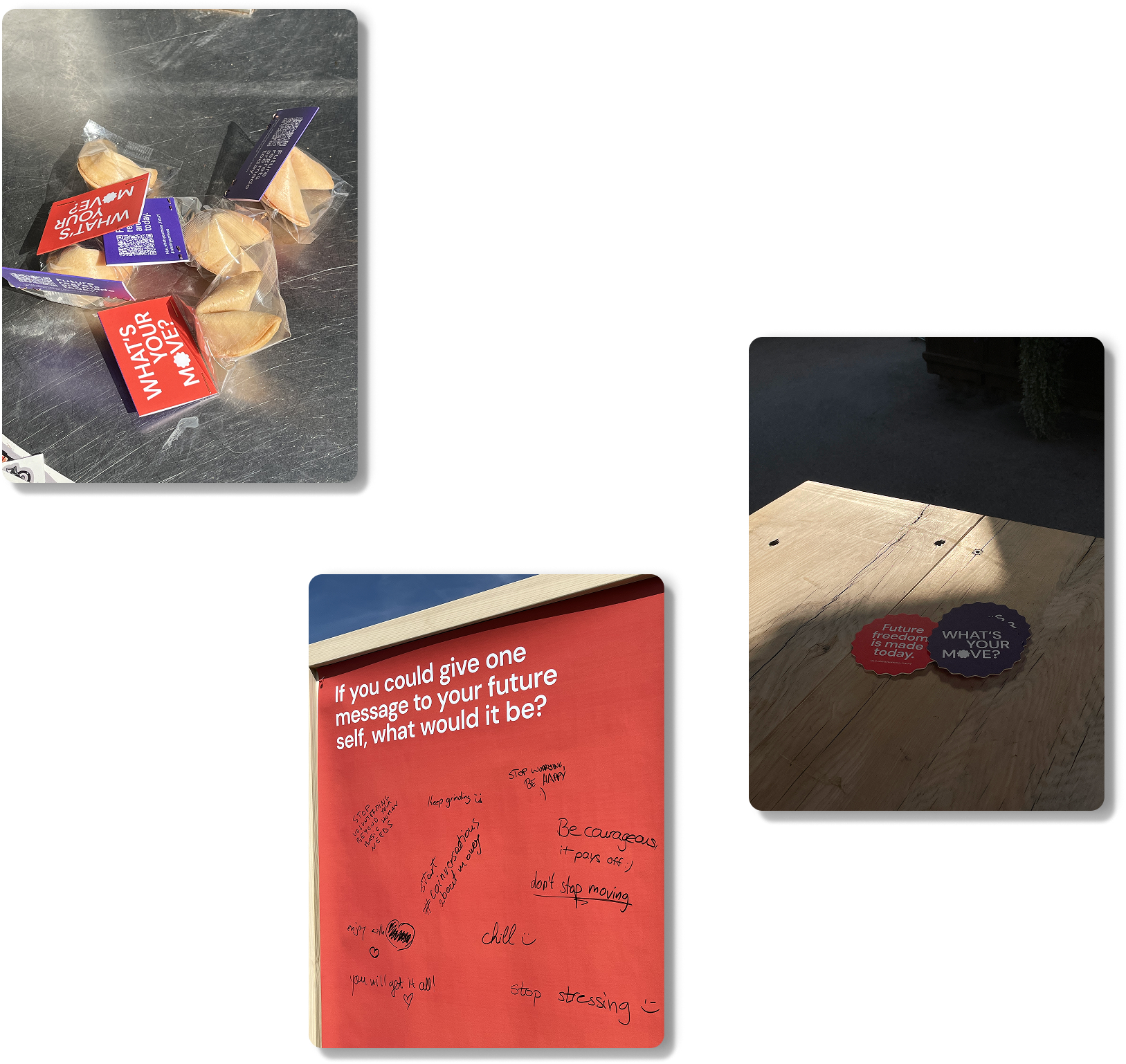
A set of physical materials: posters, stickers, pins, beer coasters and fortune cookies.
A live Wall of Moves installation.
A street survey and interview format.
A set of future activation concepts that were planned but not implemented.
The brand was designed to feel warm, empowering, dynamic and forward-thinking. FORA’s visual system used the idea of sparks, stars and small moves: every action as a spark of change, and many small sparks forming something larger together.
The claim did a lot of work. Future regrets are made today created tension. It was direct enough to stop people, but flexible enough to be adapted: future freedom is made today, future joy is made today, future well-being is made today. That flexibility made it suitable for a longer campaign system, because the structure could hold many messages without losing its core idea.
The “move” became the central unit of participation. It was intentionally small. A move could be saving more regularly, learning about investing, talking about money with a partner, reviewing subscriptions, cooking more often, reducing impulse spending, or simply taking time to think about one’s future.
What we tested
The pilot was not only a communication exercise. It was also a way to learn.
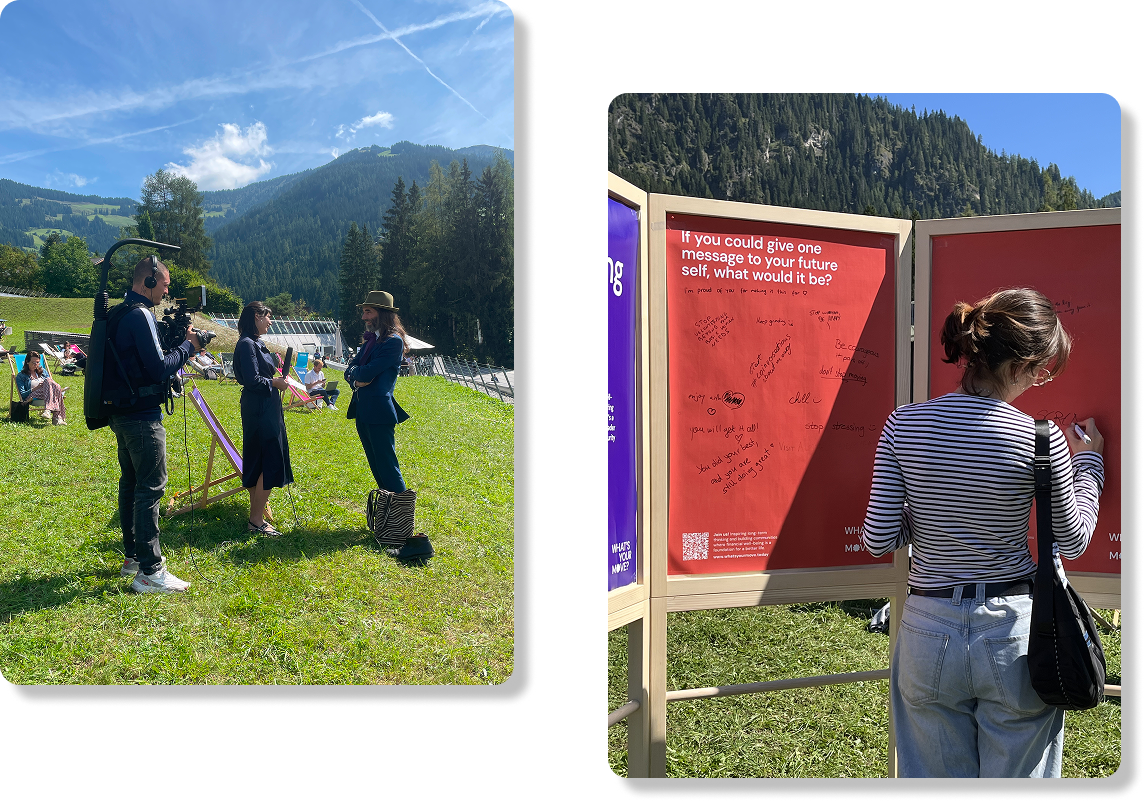
At the European Forum Alpbach, Open Future Lab and FORA tested the idea in a real-world environment with an audience more open to reflection than a typical public street setting. This allowed the team to see whether the concept sparked interest, whether people understood the question, and what kind of answers emerged when people were invited to connect money, future and everyday life.
The live activation had three functions: awareness, engagement and insight generation.
Awareness was created through posters, stickers, pins, beer coasters and fortune cookies. The fortune cookies were especially effective because people already associate them with the future; they became a playful bridge into the topic. All physical activities led back to the website through tracking links, and the QR code on the fortune cookie packaging was the most-clicked link.
Engagement was tested through the Wall of Moves, where people were asked: If you could give one message to your future self, what would it be? The street survey asked two further questions: If you could change one habit to improve your financial future, which would it be? and What is one regret you definitely don’t want to have when you’re older?
Insight generation came through interviews. These conversations were crucial. They showed that people could respond deeply when the question was explained and when there was space to think.
The pilot also tested digital channels. Instagram became the most active channel, with 42 posts across moves, educational content, study insights and interviews. The website was designed not only to invite people to share their moves, but also to collect and present documents, insights, podcasts, recommendations and inspiration for long-term thinking.
What people shared
The interviews generated around 80 moves. They showed that people interpret future financial well-being in very different, but very human, ways.
Some responses were directly financial. People spoke about investing monthly, starting earlier, learning about ETFs, saving regularly, diversifying income, building a safety net, and preparing for retirement.
“So for me, this would be a habit that I would love to develop as a young person to keep investing as little as I have into the stock market or saving aggressively and living a very minimalistic lifestyle so that I can have a better future financial well being.”
Others were about everyday habits: going to the farmers’ market instead of the supermarket, cooking instead of eating out, spending less on small recurring purchases, reducing doomscrolling and online shopping, or finally doing the paperwork needed to claim money back.
“Sometimes you have like 50 euros, you could get back. But you have to fill out some formulas and I don’t do that. So I think I lose a lot of money by not doing that.”
Many answers went beyond money. Participants connected financial well-being to self-confidence, mental health, family, values, education, community, and the ability to become who they want to be. One participant described investing in himself through new skills and knowledge: “I invest in myself in a way like I try to always learn new skills that I think can be valuable for me for now, but also in the future”. Another spoke about not wanting to work so much that she missed time with friends and relatives: “I can’t really think about myself alone. I also really think about my family, my mom, my dad, my sisters, also my close friends.” Others talked about money as a condition for independence, especially for women, or as a way to care for family and future generations.
One of the strongest themes was conversation. People repeatedly said that money needs safer spaces: less shame, less judgement, more openness and compassion. This confirmed that future financial well-being is not only about tools and information. It is also about language, confidence and social permission.
“Start regularly to talk about money and to surround yourself with people with whom you can in fact openly talk about money without judgment, with openness and so to start the conversations about the money.”
The interviews also showed the power of regret as an entry point. Asking people what they did not want to regret later opened up answers that were specific, emotional and actionable. But it also showed the challenge: regret can trigger reflection, but it does not automatically create action.
“I think I would regret if I wouldn’t do something just because I was afraid to do it. It can be on any different levels. It can be in my career. It can be in my relationship. It can be in my personal life, you know, or my choices.”
What worked
The pilot worked best when it was tangible and conversational.
In person, the concept was easy to explain. People understood it, liked it and often responded with thoughtful, personal answers. At Alpbach, the team received positive feedback, and the brand identity helped make a complex research topic feel accessible and alive.
The branding process itself was smooth and efficient. The identity translated the research into something visible, emotional and flexible. It created a strong base for future use.
The physical touchpoints worked as conversation starters. Fortune cookies, pins, posters and the Wall of Moves gave people something to notice, touch, take or respond to. They made the abstract idea of long-term financial well-being more concrete.
The interviews worked as a research method. They gave Open Future Lab a richer understanding of how people talk about future financial well-being when prompted in everyday language. The responses were not just campaign content; they were qualitative insights.
The pilot also proved that there is interest in the topic. With little to no media budget, the project still reached 14,740 people on Instagram, 322 website visitors, generated 707 page views, produced 15 interviews and collected approximately 80 moves.
What did not work yet
The pilot also made its limits visible.
The biggest challenge was the call to action. The question What’s your move? was strong, but also too open for many people to answer immediately. When explained in person, it worked. Online or at first glance, it was less clear what people were expected to do: share a thought, join something, change a habit, follow a channel, or simply reflect.
This revealed an important learning: before asking people to act, the project needed more awareness-building. People first needed to understand what financial well-being means, why it is not only about money, and how a small move can matter.
The second challenge was scope. The original ambition was close to movement-building, but the available time, budget and internal capacity were more suited to a pilot. A real movement would require continuous content, community management, partnerships, media work, local activation and a clear pathway for participation.
The third challenge was focus. Several future ideas were developed — a Body Doubling group and webinar, a No Regrets Club, Move Ambassadors, micro-community events, festival presence, starter kits and further Walls of Moves — but these were not implemented.
The fourth learning concerned collaboration. The project would have benefited from an even tighter connection between research and communication. The scientific foundation was strong, but the translation of research into ongoing content, prompts and interventions required more structured collaboration than the pilot could sustain.
What we learned for future work
The pilot produced clear principles for what should come next.
First, keep it simple. A movement or public-facing tool needs to be easy to join. We cannot assume that people can immediately translate a complex topic into a personal statement or action.
Second, go step by step. Small, repeated actions matter more than dramatic life-changing moments. Communication should nudge people toward achievable habits.
Third, do not prescribe answers. Financial well-being is subjective and contextual. The role of Open Future Lab is not to tell people what is right for them, but to ask better questions, facilitate reflection and create conditions for action.
Fourth, measure and learn continuously. Every format should be treated as a test: what attracts attention, what creates understanding, what leads to action, and what produces useful insight.
Fifth, be clear about the sender. The Open Future Lab brand should be visible and active, because the Lab’s research credibility is an asset. A public-facing initiative needs trust, and trust needs a clear source.
Finally, choose focus over breadth. The pilot tried to speak to many audiences at once. Future development should start with smaller segments and sharper use cases: for example, young adults starting their financial lives, women seeking financial independence, people in life transitions, or communities interested in peer support. This should also shape the channel strategy. Rather than relying mainly on owned channels and push communication, future roll-outs should explore more targeted routes through trusted voices and existing audience contexts — such as influencer partnerships, podcasts, TV or radio formats, community media, newsletters, schools, employers, events or topic-specific communities. The question is not only “what do we want to say?” but also “where are people already listening, watching, gathering and trusting?”
A successful pilot — ready to live on
What’s Your Move? did not become a full cultural movement in 2025. It became something more appropriate and more useful: a successful pilot.
It created a brand, a claim, a website, a visual system, a manifesto, public activations, interview material, around 80 moves and a clear set of learnings. It showed that people are willing to talk about future financial well-being when the topic is framed in human terms. It showed that regret can be a powerful trigger for reflection. It showed that small actions are an accessible way into a big topic. And it showed that communication can become research when designed to listen as much as to broadcast.
The next step would require more time, stronger focus and sustained ownership. The foundation is there: the materials, the insights, the formats, the questions, and the proof that the idea resonates.
What’s Your Move? can live on — if someone is willing to take it further.