
Social Compounding: From research to card deck
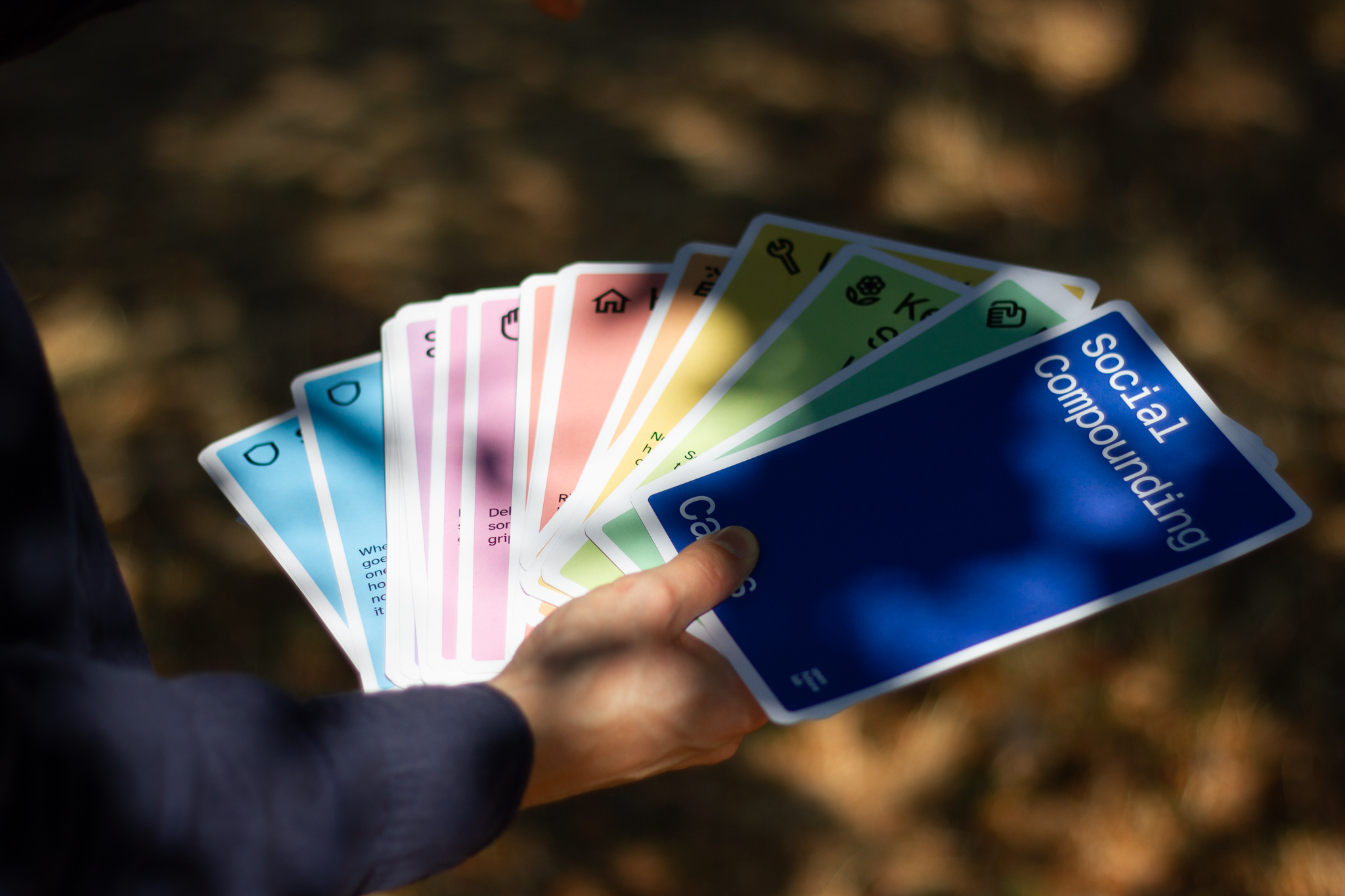
Financial compounding needs money to begin with; where there is nothing to set aside, it simply can’t start. Social compounding turns this around. It runs on participation rather than capital, and it grows through use, because using a shared fund, a co-operative or a common archive is what builds it.
With Social Compounding, we turned this idea into a card deck that groups can work with, built on real cases from around the world and paired with workshop methods. We tested it with 13 participants in spring 2026 and at European Forum Alpbach in September 2026, and the final deck is now on the Social Compounding microsite.
Why we made it
Our research The missing us builds on interviews with 26 people across 13 countries about how they picture their lives and futures. One person in Croatia told us, “It’s much easier to borrow money from banks. Borrowing money from people, it’s actually a very humiliating thing.” Many others felt the same pressure to look self-sufficient, even while depending on systems and people in ways that often stay invisible. When they imagined the future, they jumped between their private lives and planetary crises. The everyday us in between was the hardest to picture. Without it, independence becomes the safest story to tell about oneself.
What it is
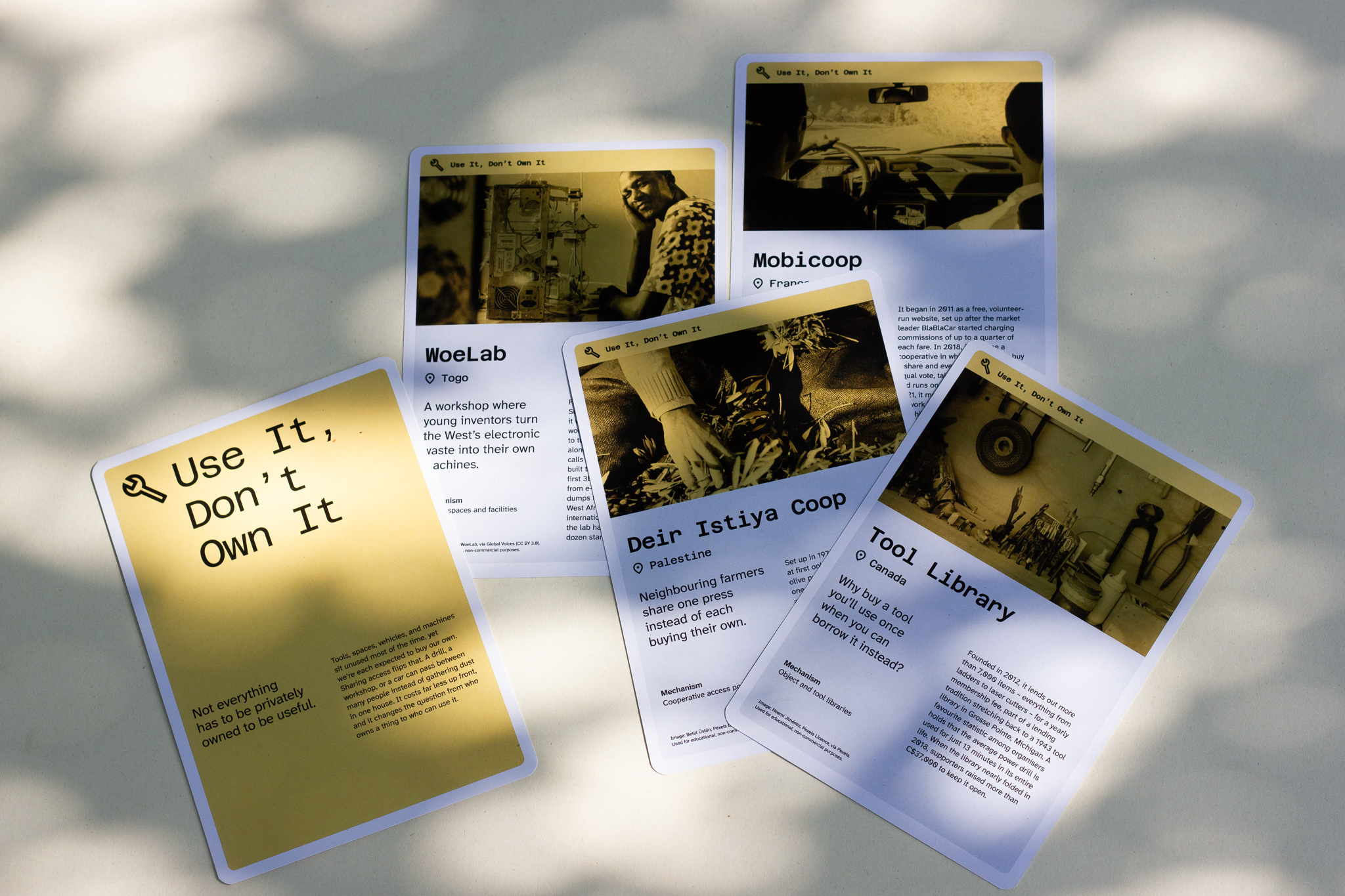
Social Compounding is a deck of 48 real cases, in 12 patterns, of people building financial and social resilience together. Many grew from mutual aid and grassroots movements, and all are imperfect but worth bringing into a room. With workshop methods, they help people spot the “missing us” in their lives and organisations: the gap between the future they picture for their family and the direction the planet is heading. What could resilience look like in that gap?
How we got there
Starting from our research on the missing us, we decided to explore the gap: how do people organise themselves and support each other independently in different situations? We began by collecting signals, every instance our internal team found that resembled a social wealth practice, from seed libraries and historic community currencies to rapid responses to disasters. Over a couple of months the spreadsheet grew past 80 entries. We then trimmed it down and built a first version of the map, clustering the signals under what we then called larger topics, from more-than-human agency to shared risk pools. A second review by one of our researchers narrowed these to 12 clusters, which became 12 cards, and we ran a first testing session with invited participants.
What we’ve seen so far
In spring 2026 we ran a collaborative content testing session with thirteen participants, most of them unfamiliar with the concept at the start. Two things came through. The cards close the comprehension gap: people left understanding social wealth and, almost without exception, wanting to take it further. The cards also work as conversation-starters, not lectures, which is the mechanism the whole programme depends on.
- Almost all participants left curious to learn more (12 of 13).
- Most participants gained a clearer understanding of social wealth (10 of 13).
- A clear majority of card ratings said a card could start a meaningful conversation without guidance (about two in three, 68%).
- Very few card encounters drew a “not relevant” response (6 of 122).
More detailed responses pushed us to develop the cards further. We learned that the case studies were what people responded to, so we turned the 48 case studies behind the 12 initial cards into individual cards. We produced a new version for Alpbach 2026 and piloted the first challenge-based workshop structure.
Alpbach
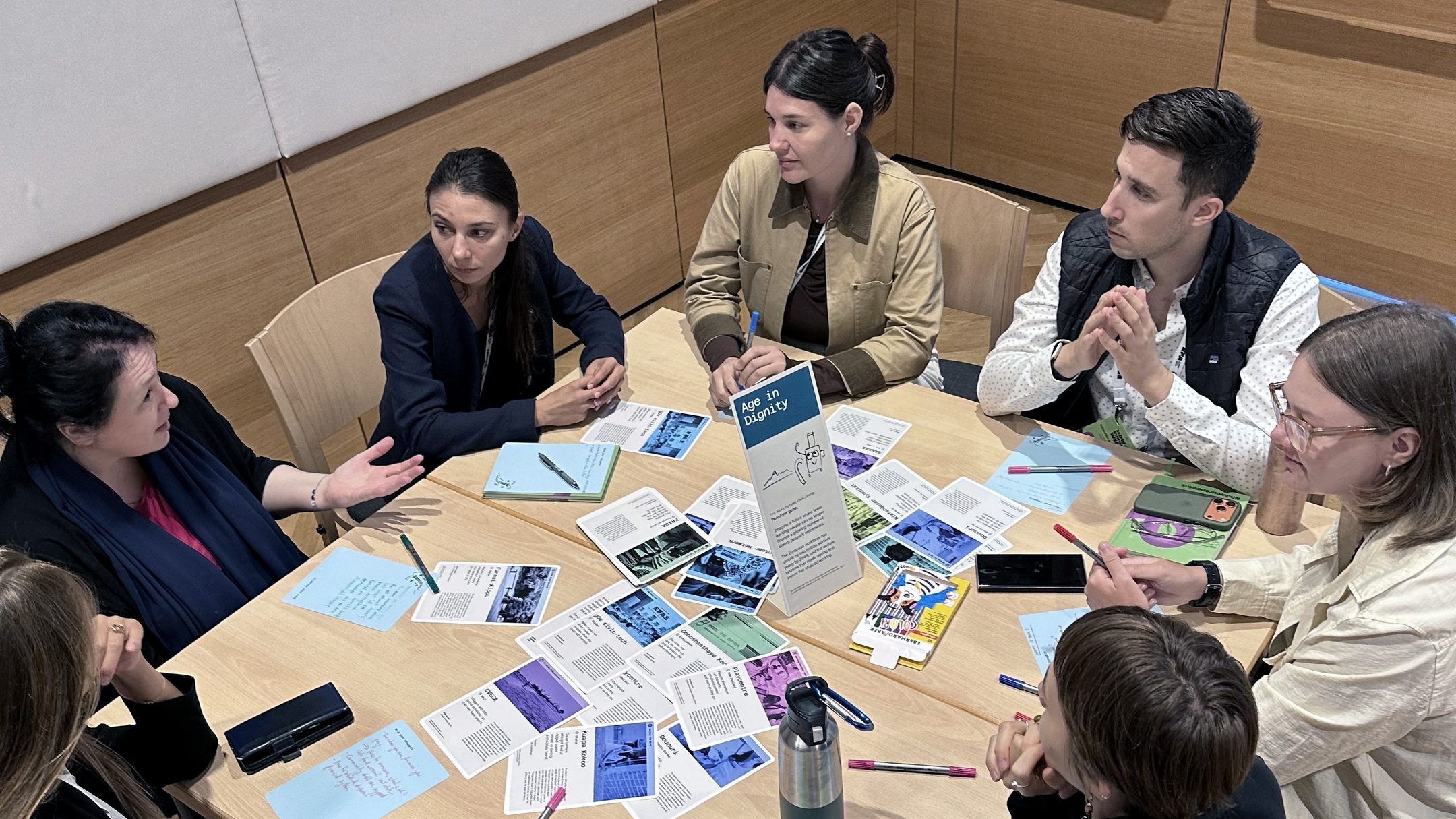
In September 2026 we brought the project to European Forum Alpbach and used the deck to generate new ideas. Four tables each took a near-future challenge: insurance failing, pensions disappearing, cost of living maxing out, careers becoming unstable. How it ran:
- Run the challenge past the cards.
- Share a round of what-ifs out loud. Aim for range over quantity, and don’t filter early.
- Keep the ones with charge, and flip them into present-tense statements set in the near future.
- Imagine the actual service, then stress-test it against the Critical Principles.
What we learned:
- In a single one-hour session, groups could move from a challenge to early, workable ideas for addressing it.
- The conversation also surfaced angles on the challenges that we hadn’t recorded before, so the deck worked as a research instrument as well as an ideation tool.
- Several participants asked for the deck, or for help building on the method, which is an early sign the format is desirable.
Other methods
The Alpbach challenge exercise is our tested method, but not the only one. The deck is built to work at different scales and settings, so what we learned there led to a final card iteration with a cleaner layout and two more methods, both still untested. In Make the Case, groups build an idea from several cards and defend it against a sparring partner. In Take a Card Home, individuals draw cards one at a time and write about what each could look like in their own community.
Where it goes next
At the time of writing, the cards are with service design students at Kristiania, who are using them to address the challenge of career financing for young creatives. We are also in early discussions with an NGO Academy contact about introducing the topic there. Beyond these, we have several directions for developing the project further, at this stage broad directions rather than fixed plans.
Thank you to everyone who took part in testing and shaping the cards along the way.
Print it, play with it, take it into your workshops, classrooms and conversations: the Social Compounding microsite has the full deck, the Critical Principles and the methods to get started. We hope it lives on beyond the lab and takes on a life of its own.