
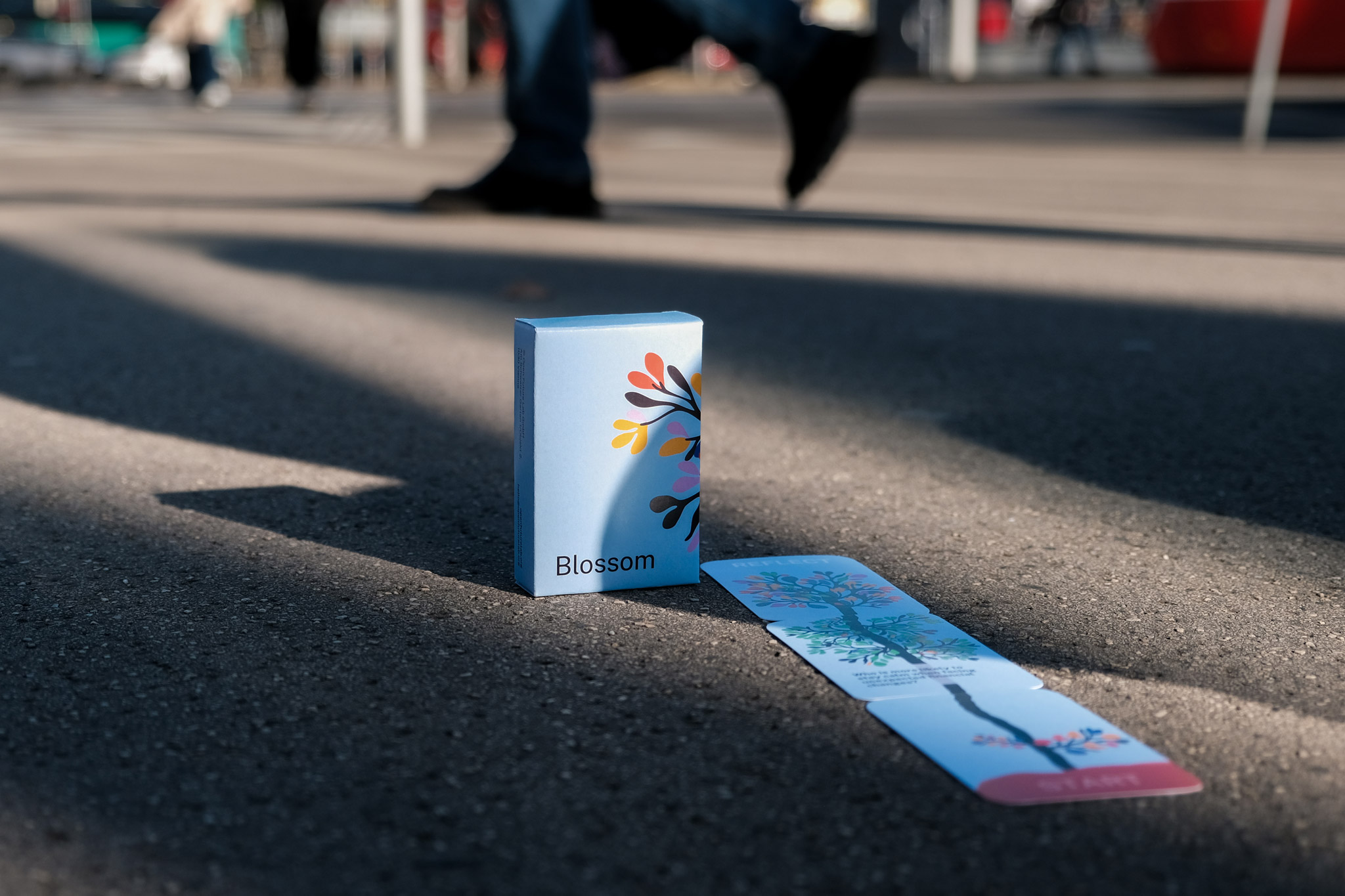
Parenthood is one of life’s most transformative stages. It brings joy and fulfilment, but also new responsibilities and complex decisions about the family’s future. At the heart of many of these changes lies money, shaping everyday routines and long-term plans alike. Yet research shows that many couples rarely talk openly about it, even as financial decisions continue to shape their lives.
Blossom was created by our lab to support this exact stage of life: a conversation card game that helps couples and (future) parents have more open, meaningful conversations about their everyday life, financial well-being, and parenting while growing a tree together.
If you’d like to try Blossom yourself, you can download the printable version here.
Why we created Blossom

Research conducted by ERSTE Foundation and the University of Tartu (Beyond Money) shows that financial well-being is not one-dimensional. It is shaped by three essential elements: security, freedom, and pleasure. Supporting all three is key to building stronger and more resilient financial lives. But this cannot be achieved through budgeting alone, it calls for open reflection, shared agency, and honest conversations about money too.
However, our research project, Navigating Parenthood, revealed: many parents rarely talk openly about money. Cultural taboos, emotional stress, and the mental load of caregiving often make financial conversations feel too personal or overwhelming. Yet talking about money at home matters. Honest and reflective conversations about money can strengthen not only financial stability but also emotional connection and shared understanding (Family Financial Socialisation Theory, Gudmunson and Danes, 2011).
Blossom was created in response to this need: to help break the taboo around money talk and make these conversations accessible, enjoyable, and emotionally safe.
Our development journey
Blossom’s development began in early 2025 and unfolded in three main phases.
Phase 0: The learning curve.
We initially built a strategic board game called Landscaper, but internal testing showed that its competitive mechanics made meaningful conversations harder. After multiple workshops, we changed course and began shaping a game that puts conversation first. That’s when Blossom emerged.
Phase 1: Turning research into playable questions.
We worked side by side as researchers and designers to develop Blossom 1.0. We focused on what couples really needed to talk about and how to invite those topics gently. During pilot sessions with couples, we watched closely where conversation flowed naturally, where it stalled and which questions helped them move from answering to reflection.
Phase 2: Deepening the emotional realism.
By mid-2025, we expanded the game’s scope and emotional depth. We validated the questions with 50 parents on Prolific, reorganized the themes to better reflect family life, and collaborated with a family psychologist to ensure the content felt realistic, supportive, and engaging. This is how in August 2025 we finalized the analogue version, Blossom 2.0.
Bringing Blossom to life
In September 2025, we launched a four-week longitudinal study with ten couples from Central and Eastern Europe (Slovakia, Hungary, Romania, and Austria). Our goal was to examine how conversations developed over time and how participants experienced them. We gathered insights through pre- and post-study questionnaires, weekly check-in surveys, and follow-up interviews.
How the game works
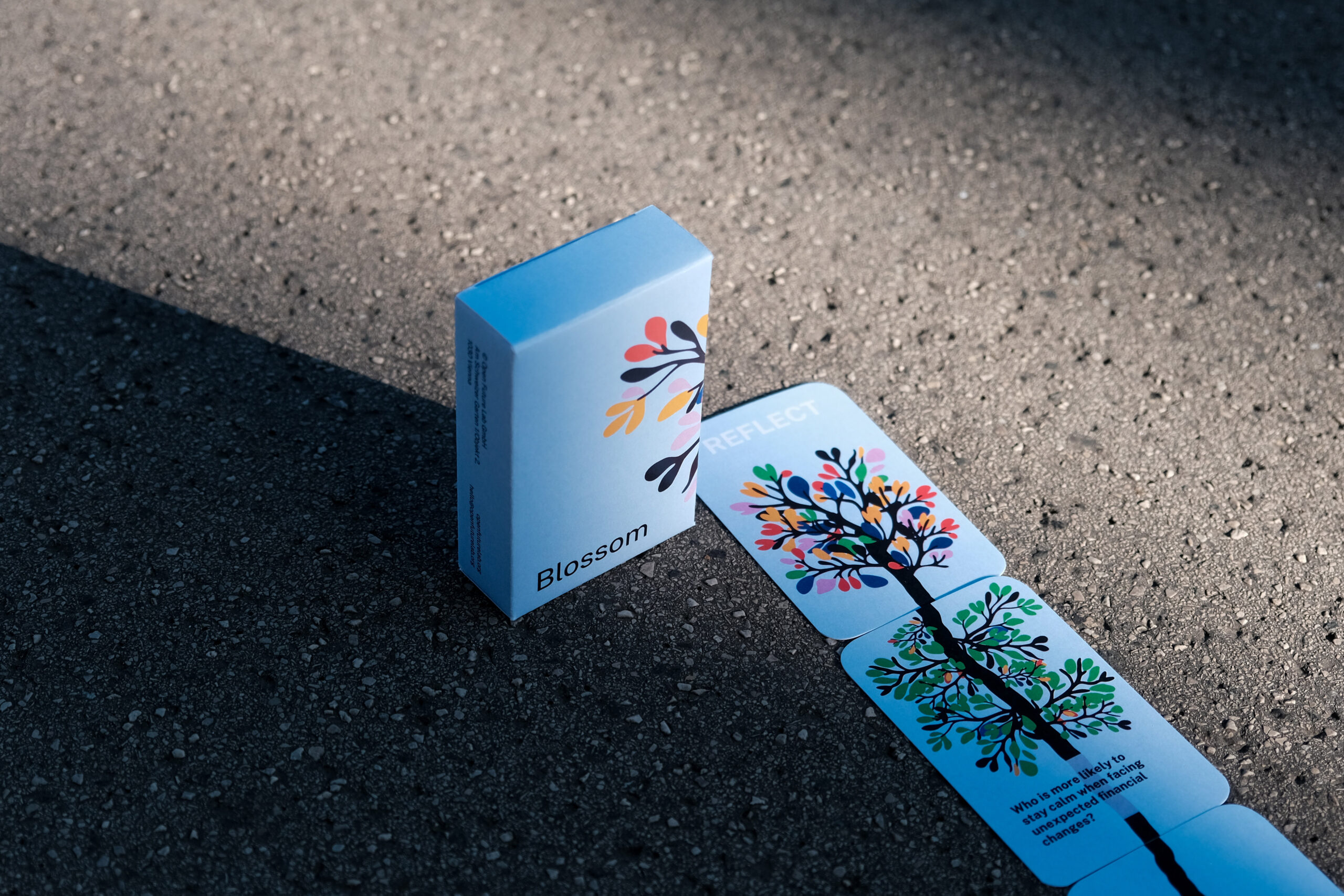
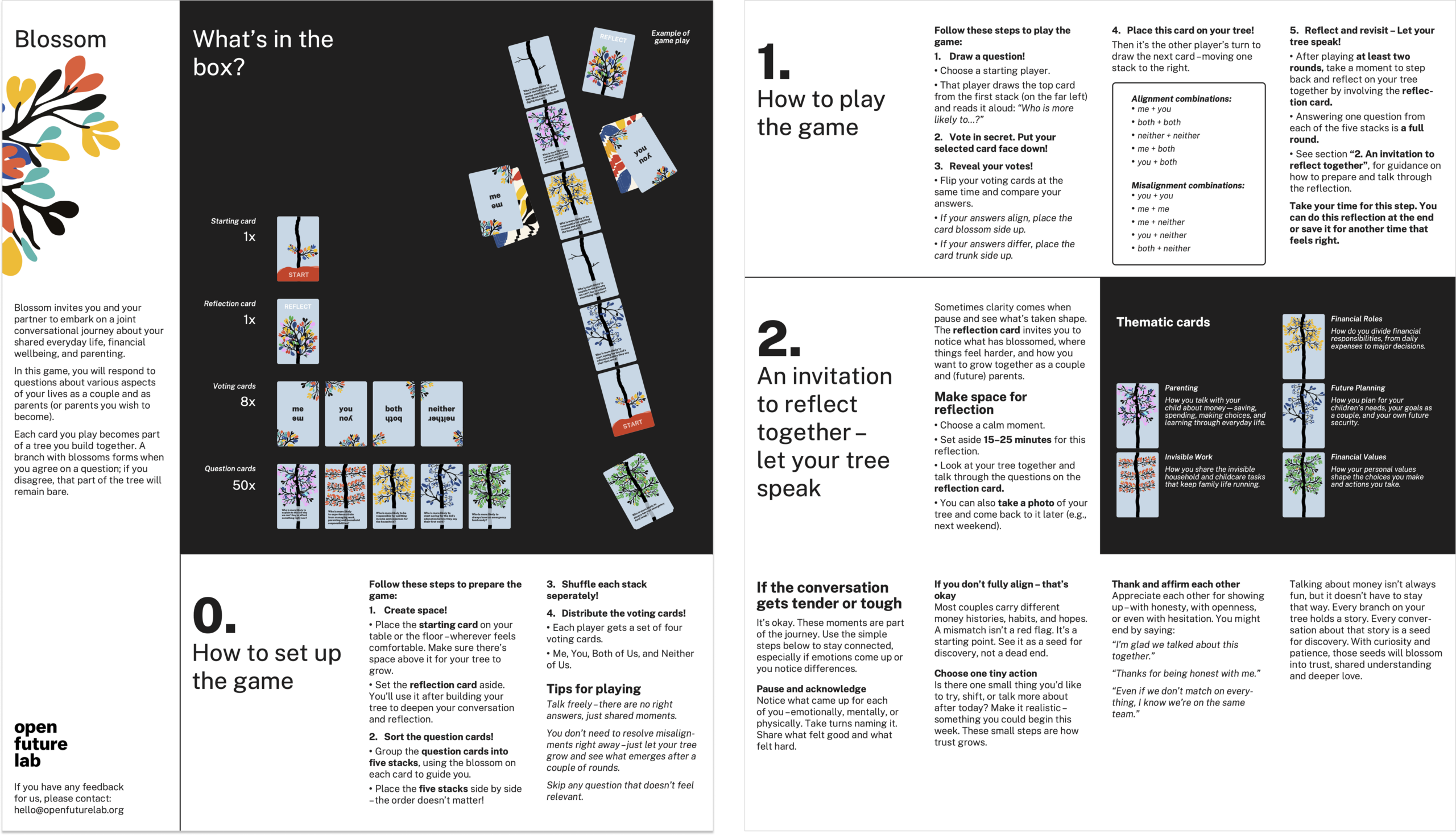
Blossom includes a manual, a starting card, a reflection card and 50 question cards, organised into five topic areas (10 cards each).
Couples begin with a set of “Who is more likely to…” questions, alongside a few open-ended reflection prompts. Each card invites both players to reflect on who is more likely to act in a certain way or face a particular situation. As they discuss and decide together, their answers form a visual pattern: a blossoming tree that gradually takes shape.
Over time, the tree becomes a reference point: blossoms appear where they align, while new branches form where their perspectives differ.
The questions explore five main areas:
- Parenting – how parents talk with their child about money: savings, spending, making choices and learning through everyday life.
- Invisible work – how couples share the often-unseen household and childcare tasks that keep family life running.
- Financial roles – how couples divide financial responsibilities from daily expenses to major decisions.
- Future planning – how parents think about their children’s needs, your goal as a couple, and your own future security.
- Financial values – how personal values shape everyday choices and actions.
While there could be some exchange throughout the card play, the conversation will deepen once the tree has visibly emerged. At that point, the final reflection card with three reflection questions invites players to notice what stood out for them: what felt easy to agree on, what felt harder to talk about, and how they want to grow together as a couple and as (future) parents. Developed in collaboration with a family psychologist, the also offers gentle guidance for staying connected if the conversation becomes tender or emotionally challenging.
Through these conversations, Blossom helps couples connect more deeply, turning conversations about financial well-being and everyday life into something natural, playful, and human.
Testing insights
Over four weeks, we tested Blossom with ten couples from Central and Eastern Europe (Slovakia, Hungary, Romania, and Austria).
We used a repeated-measures design to examine how conversations evolved over time at the individual and couple levels.
Before testing began, participants completed a pre-test survey assessing three standardised measures: Financial Communication (Saxey et al, 2025, 98), Financial Well-being (Beyond Money, 2025) and Relationship Satisfaction (Rogge, 2007). The same measures were collected again after the four-week period. In addition, participants completed three weekly check-in surveys reflecting on the tone, quality, and overall experience of each game session.
Participants ranged in age from 29 to 53 (M = 41) and the sample included a mix of couple types. Most couples had one child, typically aged 0–2 years, and 30% also had a child aged six or older. The sample skewed toward higher socioeconomic status, with 65% holding a Master’s degree and most households earning over €90k+ per year.
Overall, the results indicate that Blossom supports its core purpose: guiding couples and (future) parents have more open, meaningful conversations about everyday life, financial well-being, and parenting.
Participants described the experience as emotionally safe and surprisingly enjoyable. Even those who began feeling unsure or nervous said the atmosphere quickly became open and calm, making it easier to speak honestly without the discussion turning into conflict.
“It was more engaging than I initially expected.”
“The atmosphere was really good and very open…”
“We were relaxed, we were curious about the questions. I remember I felt a bit nervous in the beginning, after that I relaxed.”
“This was a thought-provoking game which made you really think and discuss.”
Blossom helps participants talk about finances in a way that feels structured but still light enough to start. For some, that structure also made it possible to approach money topics that had previously felt uncomfortable or “off-limits”, shaped by family norms or past experiences.
“…discuss financial topics in a structured and in the same time, fun …”
“…nice to discuss this…with a calm set of mind and keep an open mind...”
: “…with my partner in this game, it’s…easy to talk about different topics, even though they were taboo in my family.”
Beyond being a conversation starter, Blossom appears to build awareness. Many participants described noticing their own habits and priorities more clearly, thinking more about the future, and continuing to reflect after the game ended.
“I think I started just thinking on the background of my mind, thinking a bit more about the future…”
“…I should also think more about this (financial planning and discussion about saving and the future and so on) and maybe we talk to our son that I should give my view…”
“I never thought that I do not look at how much grocery costs, and do not try to, you know, find something cheaper. I just try to find something closer.”
In several cases, that awareness translated into concrete next steps, such as agreeing to change spending habits, listening to financial podcast, postponing a purchase, setting up savings routines, or exploring financial options for their child.
“We realise that the invisible work actually exists…appreciating more what the other one is doing…”
“I have a dedicated savings account now…and I transfer 10% of my salary to my savings account…”
“I started to watch on TV this advertisement like open your bank account for your child. You have like free bonus or something…”
“…I’ve been listening to a bunch more financial podcasts lately compared to what I did, because I just absolutely did not care about any of these at all. Like I didn’t like to listen to these topics…”
Additionally, several participants described the game as a rare moment of quality time spent together. Many couples highlighted that the biggest value wasn’t just the questions themselves, but the way Blossom created a dedicated and focused setting for conversation, which can be hard to protect in everyday life.
“…just sitting and talking around the game. It has like almost like a around the campfire feel.
“I would describe this also as well spent time…we do not have so much like intentional time to conversation.”
“…a unique opportunity for us to talk about these things because honestly, we’re not that kind of people who discuss finance…”
“…the first opportunity to like discuss it in a focused way and more purposefully….”
“It offers quality time to sit down and talk about things that matter at your stage. It’s good because you don’t always allocate enough time for these things because life is so busy…”
Finally, the interviews suggest Blossom supports deeper exchange, not just more talking. Participants said the game helped them slow down and explore how each person understood the same question, where their partner’s answer was coming from, and why they agreed or didn’t. Even when couples disagreed, the discussion itself often stayed constructive, helping them move from quick reactions to clearer understanding and, at times, shared ground. In other words, Blossom seems to turn differences into a chance to clarify meaning and learn from each other, an important ingredient of healthy communication.
“…the puzzle pieces that make up the question in her mind versus my mind are fun to talk about,”
“…it really makes you think to sort of understand what the other person’s perspective is…where is this person coming from.”
“See why did you answer this? Why do you think it is like this? … even the ones where we had agreement, it was nice to reflect why we are aligned.”
We also gathered feedback on the questions set. Overall, participants felt the topics covered in Blossom are important and relevant. At the same time, the themes that resonated most depended on life stage. Parents of younger children (around 1–2 years old) tended to connect more with questions about parenting and future planning. Parents of older children (around 5 and up) highlighted more often questions about how financial responsibilities are shared and how “invisible work” is handled at home.
Participants also suggested a few directions to expand Blossom’s content. Some wanted more questions about everyday financial safety, especially around online purchases and scams. Others proposed prompts about how cultural differences in mixed families shape spending habits and how that might influence the next generation. A few also suggested adding gentle “rules of thumb” that can spark practical conversations, such as building an emergency fund to cover several months of living costs or setting aside a consistent percentage of income each month for the future.
Looking forward
Money is not just about numbers; it’s about emotions, relationships, and values.
By transforming financial discussions into moments of connection, Blossom helps families strengthen their emotional and financial well-being. When we communicate with each other, we learn. And when we learn together, we grow stronger, just like the tree that blooms at the heart of the game.
As a non-profit lab, we are exploring the possibility of distributing Blossom through trusted parent-support organisations so that it can be used in real-world settings early on. At the same time, we are also actively looking to collaborate with partners who want to scale it up responsively, so that Blossom can support more families across a wide range of contexts.